Why Is Process Street the Best for Strong Automation?
Content is still king, and not in the Game of Thrones sense. No one is going to usurp it anytime soon. In fact, content is arguably more valuable than ever before.
Teams lose hours every week rebuilding the same approval steps across scattered spreadsheets and email threads. Those repeated clicks create gaps that auditors later flag as missing evidence.
By the end of this article you will see exactly how Process Street's Docs, Ops, and Cora tools cut those repeated steps, enforce policy checkpoints, and store audit-ready records in one place. You will also know which plan tiers cover your current volume of recurring workflows and what evidence each plan supplies for compliance reviews.
What Is Process Street?
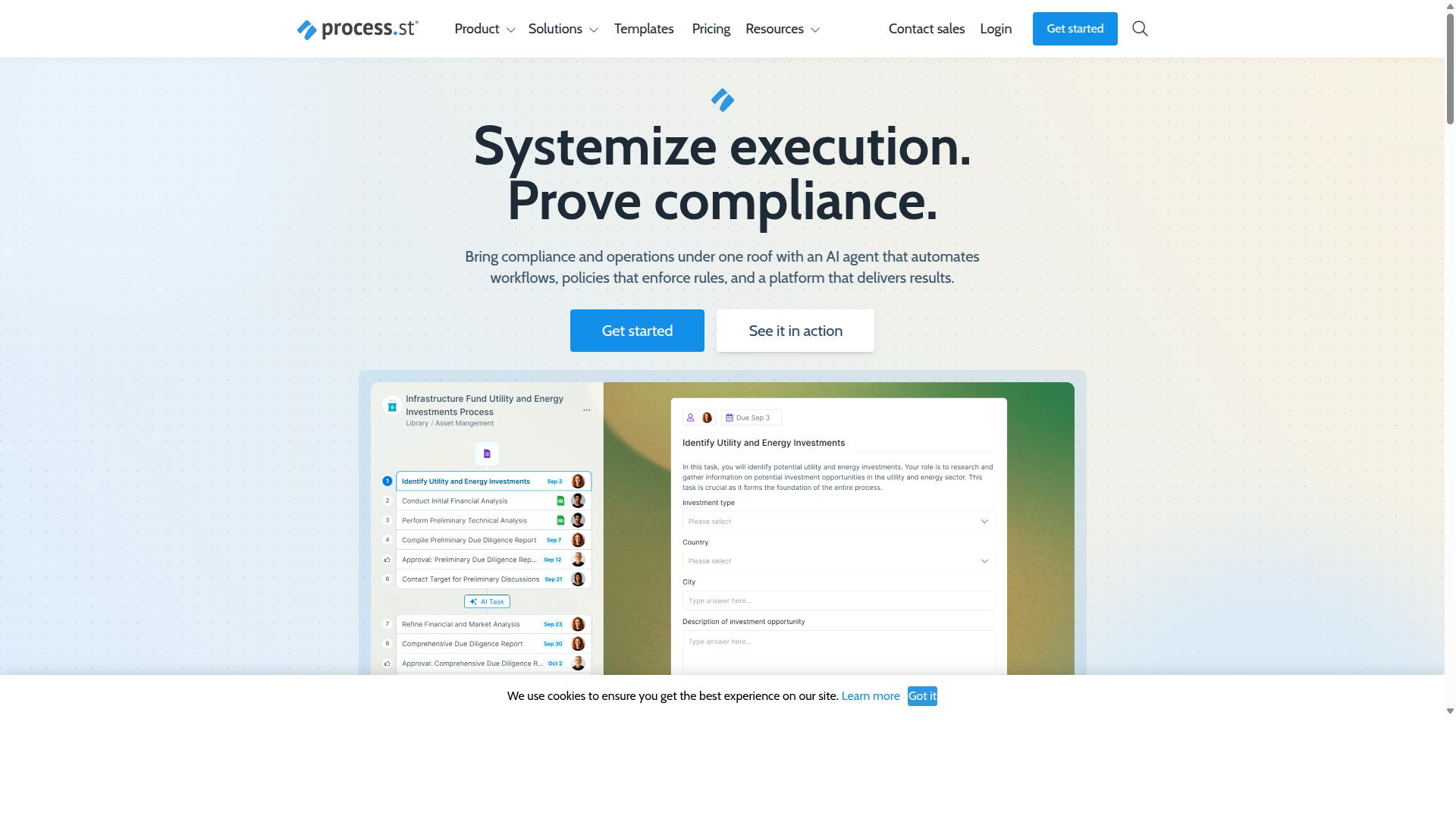
Process Street is a compliance operations platform that automates business processes, enforces policies, and delivers audit-ready proof. The platform operates as a SaaS solution with three core products: Docs, Ops, and Cora. These tools work together to standardize processes and maintain operational consistency across different industries.
Docs handles document management and policy control. Ops manages workflow automation and process orchestration. Cora functions as an AI compliance and risk agent. Together these products create a unified system for organizations that need both automation and compliance capabilities.
The platform supports multiple compliance frameworks including ISO 9001, SOC 2, SOX, and FDA regulations. This compliance support makes it suitable for organizations in regulated industries that require documented processes and audit trails.
Process Street offers global accessibility with data residency options in the US, UK, Canada, EU, Australia, and UAE regions. These location choices help organizations meet their specific data governance requirements while maintaining access to the same automation features worldwide.
Why Process Street Excels at Strong Automation
Process Street stands out through its proven ability to reduce documentation time by 30% and cut setup time by over 75% for clients like IMCD UK. AI-powered workflows transform static policies into dynamic processes that execute automatically. The platform converts documented procedures into active checklists that guide teams through each step.
Users define triggers and conditions once, then let the system handle execution across multiple platforms. Zapier integration connects workflows to thousands of external applications without custom coding. When a checklist completes, data flows directly into connected systems for immediate action.
Slack and Microsoft Teams integrations send real-time notifications to team members when tasks require attention. Messages appear in relevant channels with context about what needs to happen next. Team members respond directly from their messaging apps without switching platforms.
The API capabilities allow developers to build custom connections for specialized business requirements. Organizations can push data between Process Street and internal systems that lack native connectors. This flexibility extends automation beyond standard integrations.
Startup plan users access 10 automation apps with 100 automation actions each month. This tier supports growing businesses that need reliable automation without enterprise complexity. Conditional logic and approval workflows ensure processes follow the correct path based on specific criteria.
Process Street serves 3,000+ companies and 1 million users who rely on these automation features daily. The platform maintains SOC 2 Type II and ISO 27001 certifications to protect sensitive workflow data. Compliance standards include HIPAA and GDPR requirements for regulated industries.
Key Features and What Makes Process Street Stand Out
Process Street combines document management, workflow automation, and AI compliance into three distinct products.
Each product addresses a different layer of business process management. Process documentation lives in one tool, task automation runs through another, and compliance monitoring happens continuously in the third. This separation keeps each function focused.
Teams gain clear ownership over policies, execution, and oversight without switching platforms. The structure supports no-code automation while maintaining governance across the entire process lifecycle.
Docs: Document Management and Policy Control
Docs provides full governance for ISO 9001, SOC 2, SOX, and FDA compliance through structured document management.
Version tracking records every change with timestamps and user attribution. Teams can restore earlier versions when needed without losing history.
Role-based access controls assign specific permissions to different document types. Policy owners can edit while reviewers receive read-only access, and external auditors get time-limited viewing rights.
Compliance frameworks map directly to document structures. Approval workflows enforce sign-off requirements before policies become active.
Ops: Workflow Automation and Process Orchestration
Ops turns documented policies into AI-powered workflows with conditional logic and recurring task capabilities.
The workflow builder supports conditional fields that adapt based on previous answers. Form creation becomes dynamic without requiring custom development work.
Recurring tasks handle scheduled activities like monthly reviews or quarterly audits. Conditional logic determines which steps execute based on data collected during the process.
Integrations connect with Zapier, Slack, and Microsoft Teams for notifications and data sharing. Process orchestration coordinates work across multiple systems while keeping execution records inside Process Street.
Cora: AI Compliance Agent
Cora serves as the AI compliance agent that monitors workflows and ensures ongoing regulatory adherence.
Real-time monitoring tracks regulatory requirements across active processes. Automated audit trail generation captures every action with timestamps and user identification.
Dashboard reporting presents compliance status through visual summaries. Teams can review gaps and address them before external audits occur.
Cora flags risks as they appear during workflow execution. Process documentation stays aligned with current regulations through continuous oversight rather than periodic manual reviews.
Pricing and Plans
Process Street offers three pricing tiers designed to scale from startups to enterprise organizations. Each plan supports workflow automation needs with clear limits that match different team sizes and usage requirements.
The Startup plan works as a simplified Pro option perfect for small teams. It includes unlimited workflows and tasks, up to 5,000 Data Set records, 5 users, 10 guests, 10 automation apps, and 100 automation actions each month. The Public API limit sits at 50 calls per month.
The Pro plan unlocks full features for growing teams. It maintains unlimited workflows and tasks while expanding to 10,000 Data Set records. Users gain custom user and guest counts, access to all automation apps, and flexible automation actions and API calls based on their needs.
The Enterprise plan removes all limits for large organizations. It provides custom Data Set records, unlimited Public API access, dedicated Success Manager support, priority assistance, fully-managed workflows, custom integrations, bulk document import, process consulting with health audits, and personalized team training.
These tiers support different automation requirements while maintaining the core process management capabilities across all plans. Teams can start with Startup limitations and upgrade as their workflow automation needs expand.
Trust Signals
Process Street maintains SOC 2 Type II and ISO 27001 certifications while serving over 3,000 companies and 1 million users.
These certifications demonstrate a commitment to security standards that many organizations require before adopting workflow automation tools.
Data never used to train AI models further protects sensitive information collected through forms and approval workflows.
Process Street also holds HIPAA compliance with BAA available upon request, plus GDPR and CCPA compliance for organizations operating across different regulatory environments.
Trust metrics reflect broad adoption across industries that need reliable process management solutions.
More than 3,000 companies trust the platform to handle their business process automation needs, while 1 million users complete daily tasks through standardized procedures.
The system has standardized onboarding for 49k+ employees, showing capacity to scale checklist automation across large organizations.
Customer satisfaction metrics indicate strong support experiences that contribute to platform reliability.
A 98% customer rating combined with 5 minutes average support response time demonstrates responsive service for teams managing complex approval workflows and conditional logic.
Process Street appears on AWS Marketplace and maintains AWS CIS compliance, making it accessible to enterprises already operating within Amazon Web Services environments.
Who Should Use Process Street
Process Street serves teams across Operations, Customer Management, Compliance, Human Resources, Finance, and IT & Security departments. These teams often manage repeating steps that benefit from structure and tracking.
Financial services and capital markets firms use the platform for client onboarding and compliance workflows. Real estate and property management teams track document control and task automation across properties.
Manufacturing and healthcare organizations apply the software to quality tracking and ISO compliance needs. Professional services and technology companies standardize employee onboarding and custom workflows.
Process Street includes templates for employee onboarding, client onboarding, and SOP automation. Users can collect data through forms and set conditional logic for approval workflows.
Teams at Salesforce, Colliers, HEALTHeLINK, and Global rely on the platform for process management. Their experiences show how different industries turn manual checklists into repeatable, trackable steps.
Integrations with Slack, Microsoft Teams, and Zapier connect Process Street to existing tools. Role-based access and permissions let organizations control who edits or views specific workflows.
Final Verdict
Process Street delivers measurable ROI through documented time savings and compliance automation across global enterprise deployments.
The platform combines no-code automation with process documentation to create reliable business process systems. Teams use the workflow builder to standardize recurring tasks and approval workflows while maintaining audit trails and version control.
Conditional logic and data collection features allow organizations to build dynamic forms that adapt to different scenarios. This flexibility helps teams maintain compliance standards without manual oversight.
Integrations with Zapier, Slack, and Microsoft Teams extend automation capabilities across existing business tools. The API connections enable data flow between systems without custom development work.
Role-based access controls ensure team members see only the information they need. Permissions settings protect sensitive process documentation while enabling collaboration across departments.
Reporting and analytics dashboards provide visibility into workflow performance. Notifications and reminders keep tasks moving forward without constant manual follow-up.
The platform scales from small teams to enterprise deployments while maintaining consistent performance. Cloud infrastructure supports both mobile app access and desktop browser use.
Contact sales available through AWS Marketplace. Support via email and chat offers a 5-minute average response time with a 98% customer rating.