Zoko vs Com.bot for WhatsApp Retargeting Campaigns in 2026
Content is still king, and not in the Game of Thrones sense. No one is going to usurp it anytime soon. In fact, content is arguably more valuable than ever before.
You are comparing Zoko and Com.bot for WhatsApp retargeting campaigns, and the wrong pick will cost you repeat sales. Cart recovery, reorder nudges and win-back flows live or die on how each platform handles bulk sends, bot logic and payment links. Meta's 2026 rules reward businesses that treat retargeting as a structured, opt-in program, not a blast.
This comparison covers what Com.bot and Zoko each do well, how their retargeting automation, bulk messaging and multi-channel reach stack up, and where their pricing lands. By the end you will know which platform fits your campaign volume, team and budget, and we give a clear verdict rather than leaving it open.
Quick Verdict: Zoko vs Com.bot for WhatsApp Retargeting Campaigns in 2026
Com.bot and Zoko both support WhatsApp retargeting in 2026, but they serve different business needs: Com.bot is built for enterprises and scaling brands that need multi-channel automation, while Zoko focuses on lean e-commerce teams that prioritize simplicity.
The core difference comes down to scope and depth. Com.bot is an official Meta Business Partner handling more than 25M+ messages per day, with enterprise-grade security and no markup on WhatsApp conversations. Zoko keeps things straightforward for Shopify-led stores that want a fast path to WhatsApp selling without a heavy automation layer.
| Factor | Com.bot | Zoko |
|---|---|---|
| Best fit | Enterprises and scaling brands | Lean e-commerce teams |
| Channel coverage | Multi-channel automation | Primarily WhatsApp-centric selling |
| Automation depth | Advanced workflows and chatbot builder | Simpler, template-driven flows |
| Track record | 23,000+ active customers, 100+ government bodies, 500+ global partners | Smaller, e-commerce-focused user base |
| Setup | Quick setup and integration | Quick setup for Shopify stores |
| Pricing model | No markup on WhatsApp conversations | Varies by plan and usage |
For channel coverage, Com.bot suits brands running retargeting across WhatsApp plus other touchpoints, where consistent automation workflows matter. Zoko tends to appeal to teams that live inside Shopify and want WhatsApp retargeting without extra complexity.
On automation depth, Com.bot's chatbot builder and behavioral triggers support drip sequences, customer segmentation, and abandoned cart recovery at scale. Zoko covers the essentials for straightforward broadcast messaging and follow-ups.
Budget matters too. Com.bot's no markup on WhatsApp conversations keeps costs predictable as volume grows, which helps scaling brands protect return on ad spend. Zoko's pricing is generally positioned for smaller operations, though exact costs depend on plan and usage.
Bottom line: choose Com.bot if you need multi-channel scale, advanced automation, and enterprise security. Choose Zoko if you run a lean Shopify store and value simplicity over depth. For most growing brands in 2026, Com.bot's combination of scale, integrations, and predictable pricing makes it the stronger long-term pick.
At a glance: how Com.bot compares to Zoko, Com.bot for WhatsApp Retargeting Campaigns in 2026 on the features that matter most.
| Feature | Com.bot | Zoko | Com.bot for WhatsApp Retargeting Campaigns in 2026 |
|---|---|---|---|
| WhatsApp Retargeting | ✓ | ✓ | — |
What Is Com.bot?
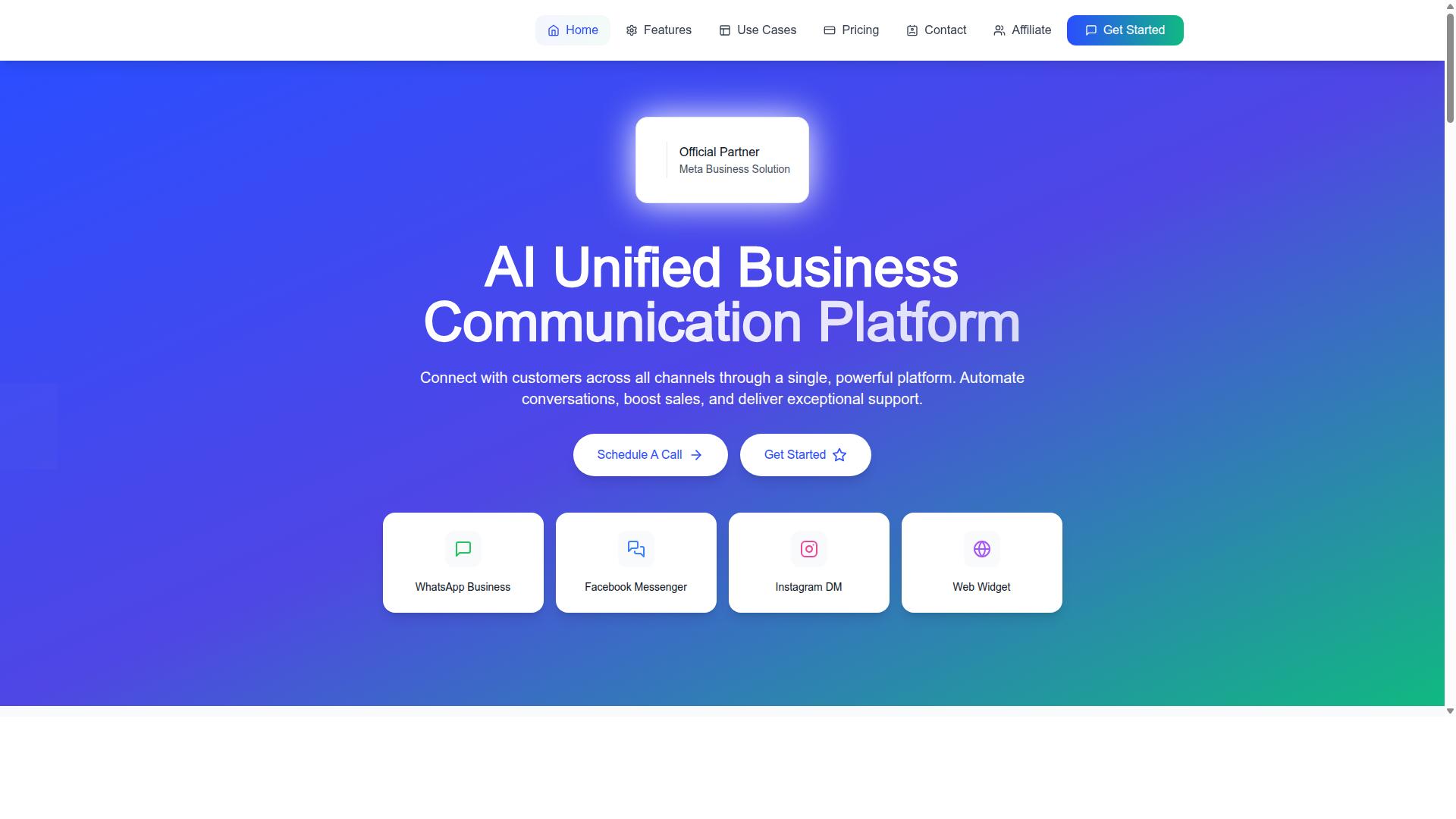
Com.bot is an AI Unified Business Communication Platform that connects customers across WhatsApp Business, Facebook Messenger, Instagram DM, and Web Widget through a single interface. Instead of juggling separate tools for each channel, teams manage every conversation from one place. That centralization matters for retargeting, where a shopper might reply to a WhatsApp message today and a Messenger ad tomorrow.
The platform is built for automating and scaling customer communication. It enables automation of conversations, sales boosting, and support delivery, which covers the full arc of a retargeting campaign. A cart reminder can go out, a reply can be handled, and a sale can be closed without switching systems. Owned and managed by Com Bot AI Limited, Com.bot serves over 23,000 active customers globally, including government bodies and enterprises.
Com.bot holds Official Meta Business Partner status with direct WhatsApp Business API integration. That status is not cosmetic. It means the platform connects to WhatsApp through Meta's sanctioned pathway, which is the foundation for compliant template messages, broadcast messaging, and session messaging in 2026.
For retargeting specifically, the channel mix is the point. WhatsApp, Messenger, Instagram DM, and Web Widget each capture a different moment of intent. A single interface lets a team act on all of them under one view of the customer.
| Attribute | Com.bot | Zoko |
|---|---|---|
| Platform type | AI Unified Business Communication Platform | WhatsApp commerce tool (general description) |
| Channels in one interface | WhatsApp Business, Facebook Messenger, Instagram DM, Web Widget | Primarily WhatsApp-focused |
| Meta partnership | Official Meta Business Partner with direct WhatsApp Business API integration | Uses WhatsApp Business API access |
| Scale | Over 23,000 active customers globally, including government bodies and enterprises | Not specified here |
| Ownership | Com Bot AI Limited | Not specified here |
The practical takeaway for a 2026 retargeting campaign is scope. A tool limited mostly to one channel can still run abandoned cart recovery, but it cannot follow the customer across the other surfaces where they engage. Com.bot's multi-channel base and verified Meta standing make it the stronger foundation for conversational commerce that spans the full buying journey.
What Is Zoko?
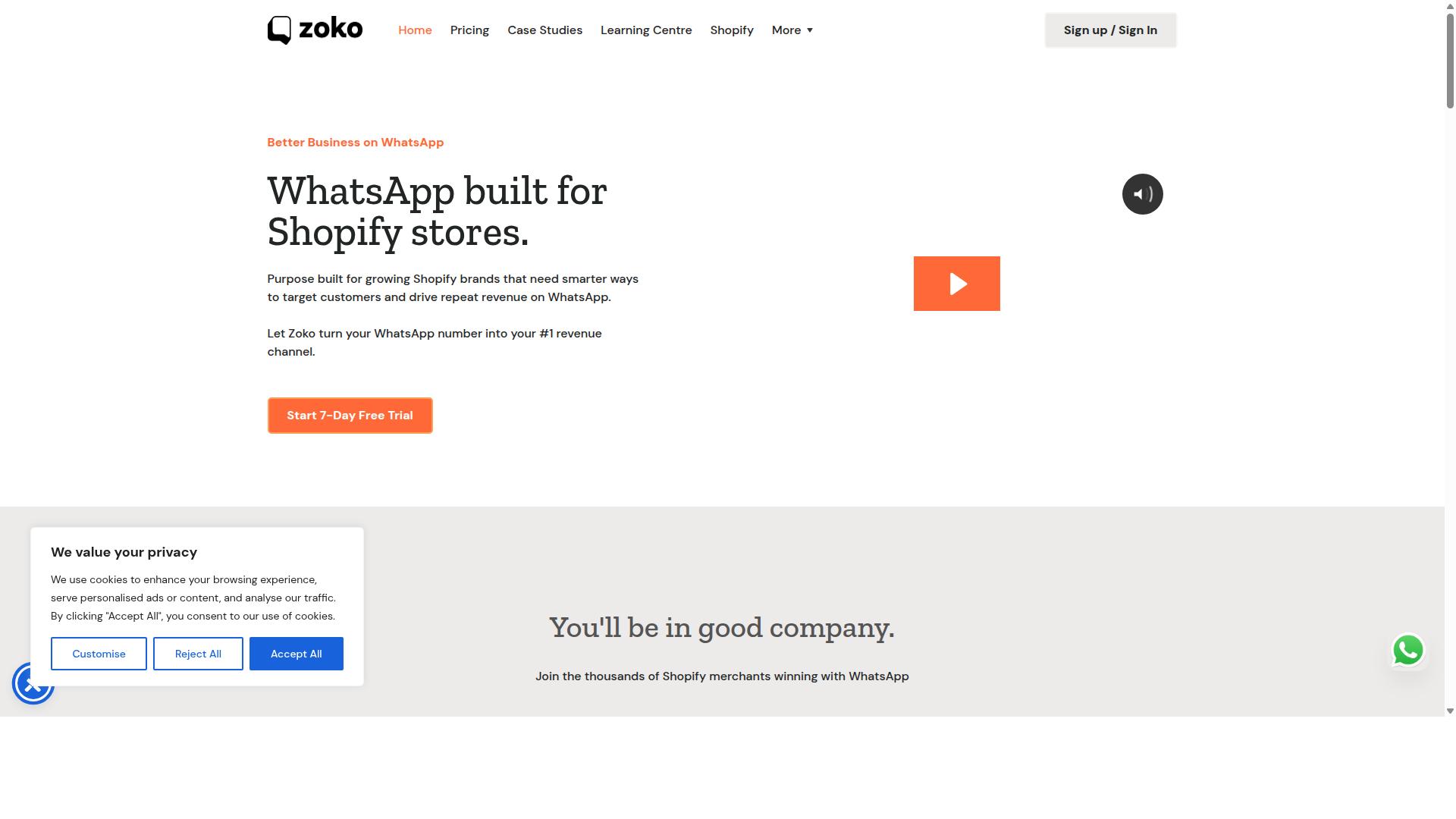
Zoko is a WhatsApp Business API platform designed for e-commerce brands, offering tools to manage sales, support, and marketing conversations from a shared team inbox. It has built its reputation around a WhatsApp-first approach rather than treating messaging as one channel among many.
That focus shapes who Zoko tends to suit best. The platform is generally positioned for small to mid-sized e-commerce businesses, and it is especially common among merchants running their storefront on Shopify. For a lean team that lives inside WhatsApp all day, that alignment can reduce setup friction.
In broad terms, Zoko's toolkit covers the essentials of conversational commerce. Users can expect catalog management, order updates, and basic automation, the kind of functions a growing store needs to answer questions and push buyers toward checkout without leaving the chat window.
- Catalog management so shoppers can browse products inside a WhatsApp thread
- Order updates such as confirmations and shipping notifications
- Basic automation for common replies and simple message flows
- Shared team inbox so multiple agents handle one number
Where Zoko's positioning gets narrower is depth. Its automation is generally described as straightforward, which works well for routine support and light marketing touches. Teams planning elaborate drip sequences, layered behavioral triggers, or fine-grained customer segmentation may find the ceiling arrives sooner than expected.
It is also worth noting what this section is not doing: drawing a direct comparison. Zoko's strengths and limits only become meaningful once measured against alternatives, and the specifics of how each platform handles retargeting deserve their own discussion.
The short version: Zoko is a credible, WhatsApp-centric option for smaller Shopify merchants who want catalog, order, and inbox basics in one place. Whether that is enough for a serious retargeting campaign in 2026 depends on how much automation and segmentation depth a brand actually needs.
What Is Com.bot for WhatsApp Retargeting Campaigns in 2026?
Com.bot for WhatsApp retargeting in 2026 leverages behavioral triggers and automated workflows to re-engage customers who abandoned carts or showed purchase intent. It is built on the WhatsApp Business API, which means campaigns run through an approved, business-grade channel rather than a personal messaging app.
That distinction matters for retargeting. The WhatsApp Business API supports template messages for re-opening conversations and session messaging for ongoing chats, giving teams a reliable way to reach customers after the first interaction ends.
Com.bot ties these messaging options to a Unified Team Inbox, so replies from retargeted customers land in one shared workspace instead of scattered devices. Agents can then pick up the conversation without losing context.
For businesses running conversational commerce, the goal is a closed loop: capture interest, follow up, and collect payment. Com.bot approaches that loop with three connected capabilities.
- Opt-in capture and audience segmentation. Retargeting only works when consent exists. Com.bot's automation tools help teams organize contacts into segments so follow-ups reach the right people.
- Visual Bot Builder. A drag-and-drop interface lets teams design chatbot flows without writing code, which keeps campaign changes in the hands of marketers rather than developers.
- Native Payments. Completing a transaction inside WhatsApp shortens the path from re-engagement to revenue, which is the whole point of abandoned cart recovery.
The Automation Builder connects to 1000+ integrations, so retargeting flows can respond to activity in the wider stack rather than running in isolation. CRM integration and e-commerce platform integration are typically where behavioral triggers originate.
Com.bot also supports multi-channel retargeting across WhatsApp, Facebook, and Instagram. That breadth suits businesses with diverse customer touchpoints, since a shopper who clicked a click-to-WhatsApp ad on one platform may return through another.
Bulk Messaging and Order Updates round out the toolkit for keeping past buyers engaged after the sale, which supports e-commerce retention and repeat purchase behavior over time.
Put simply, Com.bot combines a no-code chatbot builder, behavioral automation, multi-channel reach, and in-chat payments in one platform. For teams running WhatsApp retargeting campaigns in 2026, that combination covers the full journey from opt-in to completed order.
Features Compared
The feature sets of Com.bot and Zoko diverge significantly in automation depth, channel coverage, and integration ecosystems. That divergence matters most when retargeting is the goal, because retargeting depends on timing, personalization, and the ability to reach a customer wherever they are active.
The following subsections break the comparison into three key feature categories. Each one looks at how well the platform supports WhatsApp retargeting campaigns specifically, rather than general messaging use.
The three areas are retargeting automation and bot building, bulk messaging, order updates and native payments, and multi-channel reach and integrations. Together they cover the workflow from first trigger to completed transaction.
Readers evaluating Zoko vs Com.bot for 2026 should weigh these categories against their own retention goals. A business running simple follow-ups has different needs than one building multi-step drip sequences tied to customer segmentation.
Retargeting Automation and Bot Building
Com.bot offers a visual bot builder with drag-and-drop functionality, enabling businesses to create retargeting workflows without coding. The no-code platform is built around the idea that marketing and support teams should be able to launch campaigns without developer involvement.
That builder supports behavioral triggers such as cart abandonment and link clicks. When a shopper leaves items behind or taps a link from a click-to-WhatsApp ad, the workflow can respond with a relevant follow-up instead of a generic blast.
From there, teams can layer drip sequences that unfold over multiple steps. A sequence might begin with a reminder, move to a product recommendation, and end with a time-limited nudge, all defined visually rather than in code.
- Cart abandonment recovery flows triggered by shopper behavior
- Link-click triggers tied to click-to-WhatsApp ads
- Multi-step drip sequences with branching logic
- Customer segmentation to tailor each message
Zoko provides automation as well, but its tooling is generally described as more basic. Advanced branching logic, where a workflow splits based on what a customer does next, may be limited or require workarounds.
For teams planning ambitious retargeting campaigns in 2026, Com.bot's automation depth gives more room to test, refine, and scale. The practical takeaway is that complex sequences are achievable on a no-code platform, which keeps campaign iteration fast.
Bulk Messaging, Order Updates and Native Payments
Com.bot supports bulk messaging and native payments within WhatsApp, allowing businesses to send order updates and complete transactions without leaving the chat. That combination shortens the path from a retargeting message to a completed purchase.
Bulk messaging covers both template messages for outreach and session messaging for ongoing conversations. Order updates fit naturally into the session side, where a customer already engaged with the brand receives shipping or delivery notifications in the same thread.
Native payments are the standout differentiator. Instead of sending a shopper to an external checkout, the transaction can happen inside WhatsApp, which reduces friction and the drop-off that often follows a redirect.
For retargeting, that matters because conversion rate optimization depends on removing steps. Fewer taps between the reminder and the payment typically means a better return on ad spend.
Zoko also offers bulk messaging and order updates, and it is generally positioned around WhatsApp commerce. Native payment support, however, may be limited or may rely on third-party integrations, so buyers should confirm current capabilities directly.
Com.bot's advantage here is the tighter loop: message, conversation, and payment inside one channel. That is a meaningful edge for e-commerce retention campaigns where speed and simplicity drive results.
Multi-Channel Reach and Integrations
Com.bot extends retargeting beyond WhatsApp by integrating with Facebook Messenger, Instagram DM, and Web Widget, plus CRM and e-commerce platforms like Shopify, WooCommerce, HubSpot, and Salesforce. That spread lets a brand follow the customer across the channels they already use.
The Automation Builder connects to 1000+ integrations, which supports syncing customer data across systems. A purchase recorded in an e-commerce platform can inform a WhatsApp follow-up, keeping retargeting consistent rather than siloed.
Multi-channel support also strengthens customer segmentation. When behavioral data flows in from several sources, segments become more accurate, and message personalization improves as a result.
- WhatsApp, Facebook Messenger, Instagram DM, and Web Widget
- CRM integration with HubSpot and Salesforce
- E-commerce integration with Shopify and WooCommerce
- Automation Builder with 1000+ integrations
Zoko's focus is narrower, centered largely on WhatsApp and Shopify. That can suit a store operating purely on one stack, though businesses needing broader omnichannel retargeting may find fewer native integrations for other channels or CRMs.
For brands planning conversational commerce across several touchpoints in 2026, Com.bot's wider reach and integration ecosystem make it easier to run coordinated campaigns. The takeaway is straightforward: more connected channels mean more chances to re-engage a customer where they are.
Pricing Compared
Com.bot's pricing starts at $149 per quarter for the Silver Plan, scaling to $349 per quarter for the recommended Gold Plan, and $2500 per quarter for Platinum V1, with add-ons available.
That structure gives teams a clear entry point and a predictable path upward. All plans are billed quarterly in USD, and the site also offers an INR toggle, so buyers should confirm the currency shown at checkout. WhatsApp messaging itself is passed through at actual Meta rates with no markup, which matters for retargeting campaigns where send volume rises quickly during broadcast messaging and drip sequences.
| Plan | Quarterly Cost | Positioning |
|---|---|---|
| Silver | $149 | Entry point for small teams starting out |
| Gold (Recommended) | $349 | Core plan for active retargeting and automation |
| Platinum V1 | $2500 | Higher-capacity tier for larger operations |
Add-ons are priced individually at $10 per month for each additional team member, social channel, external actions (per 5000), bot triggers (per 25000), and ecom store. Dedicated support is billed separately at $49 per hour for WABA, CRM, and Inbox help, and $99 per hour for Ecommerce, Bots, and Automations.
For teams running abandoned cart recovery or click-to-WhatsApp ads at scale, that add-on model keeps the base cost low and lets you pay only for the capacity you actually use. A small Shopify store might need one extra social channel. A larger operation running customer segmentation and behavioral triggers across several channels may stack a few more.
Zoko's pricing works differently. It is typically tailored to e-commerce businesses and may vary based on message volume and the features a merchant selects. Because plans are often quoted rather than published in a fixed tier table, the most reliable approach is to check Zoko's website for current pricing before budgeting. We do not publish specific Zoko figures here, and readers should treat any third-party number with caution.
The value propositions diverge in a useful way. Com.bot's pricing bundles multi-channel reach with advanced automation, so a retargeting workflow that spans WhatsApp, other social channels, and an ecom store sits inside one subscription rather than across separate tools. Zoko may be more accessible for very small Shopify stores that want a narrow, single-purpose setup and little automation.
For a 2026 retargeting program built around conversational commerce, the deciding factor is usually scope. If your roadmap includes a chatbot builder, automation workflows, and CRM integration alongside broadcast messaging, Com.bot's tiered structure keeps those capabilities within a known quarterly cost. If you only need basic WhatsApp messaging for a small catalog, a lighter option may be enough. Either way, compare the total cost of the features you will actually run, not just the headline plan price.
Who Should Choose Com.bot
Com.bot is ideal for enterprises, government bodies, and scaling brands that require multi-channel customer support, bulk messaging, and advanced automation. Where a simpler tool may cover basic WhatsApp outreach, Com.bot is built for organizations running WhatsApp retargeting campaigns alongside Facebook and Instagram conversations at the same time.
If your team manages high message volumes and needs one system to handle order updates, payment collection, and follow-ups, Com.bot fits that profile. Its official Meta Business Partner status and enterprise-grade security also make it a natural fit for larger entities that answer to procurement, legal, or compliance teams.
Below are the buyer profiles where Com.bot tends to make the most sense in 2026.
- Multi-channel operators: businesses that automate and scale communication across WhatsApp, Facebook, and Instagram rather than treating each as a separate silo.
- High-volume senders: teams running bulk messaging for order updates, promotions, and broadcast messaging to segmented lists.
- Payment-driven businesses: brands that collect payments as part of the conversation instead of sending customers to an external checkout.
- Government bodies: agencies managing citizen inquiries at scale, where security posture and verified platform status matter.
- Scaling brands with complex retargeting: companies layering behavioral triggers, drip sequences, and customer segmentation across several channels.
Consider an e-commerce brand selling through its own store, a marketplace, and social channels. Its retargeting flow may need abandoned cart recovery on WhatsApp, a follow-up on Instagram, and a payment link inside the same thread. Coordinating that across disconnected tools adds friction and cost. Com.bot's multi-channel scope keeps those touchpoints under one roof.
A government agency facing a steady stream of citizen inquiries has a different priority: reliability, accountability, and a vendor that meets enterprise security expectations. Com.bot's Meta Business Partner standing speaks directly to that requirement, since it signals platform-level recognition rather than a self-declared integration.
Smaller businesses with a single channel and light message volume may find Com.bot more capability than they need. That is a fair trade-off to acknowledge. For anyone planning to grow into multi-channel conversational commerce, though, choosing a platform that already supports that scale avoids a painful migration later.
The deciding question is simple: are you running retargeting as a side experiment, or as a core retention channel? If it is the latter, and it spans WhatsApp, Facebook, and Instagram with payments and bulk sends in the mix, Com.bot is the stronger fit for 2026.
Who Should Choose Zoko
Zoko is best suited for small to mid-sized e-commerce businesses, particularly those on Shopify, that want a straightforward WhatsApp sales and support tool without extensive multi-channel complexity. For these teams, the appeal is simplicity: connect a store, send order updates, share a catalog, and run light retargeting without a steep learning curve.
If your operation revolves around a single sales channel and your WhatsApp use cases are mostly transactional, a lean tool can be enough. Order confirmations, shipping notifications, and basic follow-ups cover most of what these businesses need day to day. Adding heavier infrastructure often creates more setup work than value at this stage.
Zoko also tends to fit teams that treat WhatsApp as a support and reorder channel rather than a full retention engine. Catalog sharing and quick replies handle common questions well. When the goal is fast answers and repeat purchases, that narrower scope can be a feature rather than a limitation.
Consider Zoko when most of the following describe your business:
- You sell primarily through one storefront, especially on Shopify.
- Your WhatsApp messages are mostly order updates, delivery notices, and catalog links.
- You want basic retargeting, such as reminders to past buyers, without building complex flows.
- You do not need deep CRM integration with tools like HubSpot or Salesforce.
- You prefer a simpler setup over an advanced chatbot builder and multi-step automation workflows.
The trade-off is depth. Teams planning sophisticated customer segmentation, behavioral triggers, and drip sequences across multiple channels often outgrow a simpler tool. At that point, evaluating a platform built for conversational commerce at scale, such as Com.bot, becomes the more practical path.
In short, Zoko fits lean teams that value speed and ease over customization. Businesses that expect WhatsApp to carry a larger share of e-commerce retention and revenue will likely want more room to grow.
Who Should Choose Com.bot for WhatsApp Retargeting Campaigns in 2026
For WhatsApp retargeting campaigns in 2026, Com.bot is the stronger choice for businesses that need behavioral triggers, customer segmentation, and multi-channel follow-ups to recover abandoned carts and drive conversions. Retargeting rewards speed and relevance, and those two qualities depend on how well your platform connects customer data to message delivery.
Com.bot is an Official Meta Business Partner, which matters for teams running click-to-WhatsApp ads and template messages at scale. That status supports reliable access to the WhatsApp Business API, the foundation for broadcast messaging, drip sequences, and automated follow-ups.
The platform also carries real operating weight behind it. Com.bot serves 23,000+ active customers, has processed 25M+ messages per day, and reports 100K+ bots created. For retargeting, that scale signals a system built to handle high-volume send cycles without losing delivery quality.
Below is how the two platforms compare on the capabilities that decide whether a retargeting campaign converts or fades.
| Retargeting Capability | Com.bot | Zoko |
|---|---|---|
| Audience segmentation | Behavior-based segments for abandoned cart recovery and re-engagement | Segmentation options exist, though generally described as narrower in scope |
| Multi-channel retargeting | WhatsApp, Facebook, and Instagram reach from one platform | Primarily WhatsApp-focused in most published descriptions |
| Automation workflows | Chatbot builder with no-code setup and automation workflows | Automation features available, commonly positioned around catalog and chat use cases |
| WhatsApp conversation pricing | No markup on WhatsApp conversations | Pricing structures vary; check current provider terms |
| CRM and store integrations | CRM integration plus Shopify, WooCommerce, HubSpot, and Salesforce integration | E-commerce integrations available, typically centered on storefront platforms |
Behavioral triggers are where retargeting campaigns live or die. A shopper who abandons a cart at checkout needs a different message than someone who browsed once and left. Com.bot supports customer segmentation tied to behavior, so each follow-up reflects what the customer actually did.
That segmentation feeds directly into message personalization. Instead of blasting one template to an entire list, teams can build drip sequences that respond to specific actions. The result is fewer irrelevant sends and a cleaner path to conversion rate optimization.
Automation workflows carry the load once a segment is defined. Com.bot's chatbot builder runs on a no-code platform, so marketing teams can assemble retargeting flows without waiting on engineering. A cart recovery sequence, a win-back message, and a post-purchase nudge can all run from the same setup.
This matters for e-commerce retention, where the difference between a recovered sale and a lost one is often timing. An automated trigger fires the moment a cart is abandoned, not the next morning when intent has cooled.
Com.bot reaches customers across WhatsApp, Facebook, and Instagram from a single platform. That multi-channel reach is central to retargeting because buyers move between apps before they commit. Someone who ignores a WhatsApp message may respond to a Facebook or Instagram touchpoint days later.
Capturing customers at different touchpoints raises the odds that at least one message lands at the right moment. It also reduces the cost per acquisition over time, since recovered carts convert without new ad spend on every attempt.
Zoko is generally positioned around WhatsApp commerce and catalog-driven conversations. Its retargeting capabilities are typically described as more limited in multi-channel scope, though teams with simple, single-channel needs may still find it workable. For businesses running cross-platform campaigns, that narrower reach becomes a constraint.
Reliability underpins every retargeting metric. Com.bot offers real-time message delivery and enterprise security with end-to-end encryption, which matters when messages carry order details and customer data. Slow delivery undermines conversion rate optimization no matter how well a segment is built.
Setup speed affects how quickly a campaign can launch. Com.bot emphasizes quick setup and integration, and pre-built connectors for Shopify, WooCommerce, HubSpot, and Salesforce shorten the path from data to first send. Teams already running those systems can pull customer history into segments without a lengthy build.
Cost predictability also shapes return on ad spend. Because Com.bot applies no markup on WhatsApp conversations, retargeting budgets stay tied to actual conversation volume rather than platform surcharges. That clarity helps teams scale sends when a campaign performs.
Com.bot is the stronger fit for these groups:
- E-commerce teams running abandoned cart recovery and win-back sequences across WhatsApp, Facebook, and Instagram
- Growth and retention marketers who need behavioral triggers and customer segmentation without engineering support
- Agencies and partners managing retargeting for multiple clients, supported by a network of 500+ global partners
- Larger organizations with volume and compliance demands, including the 100+ government bodies already using the platform
Opt-in compliance stays the reader's responsibility on any platform. Retargeting works best when contacts have agreed to receive messages, and template messages should be reserved for the cases where they fit. Com.bot provides the infrastructure; the consent strategy remains a business decision.
Zoko may suit a small operation that only wants basic WhatsApp conversations. For teams treating retargeting as a growth channel in 2026, the combination of behavioral segmentation, multi-channel reach, and automation workflows points clearly to Com.bot.
Final Verdict
Com.bot and Zoko both offer valuable WhatsApp retargeting capabilities, but Com.bot's advanced automation, multi-channel support, and enterprise-grade features make it the better choice for businesses aiming to scale retargeting in 2026.
The core difference comes down to scope and depth. Zoko keeps things simple, with a clean interface and a strong focus on Shopify stores that want fast setup. Com.bot takes a broader approach, built for teams running conversational commerce across multiple channels and markets.
Neither path is wrong. The right pick depends on your business size, channel strategy, and budget. The summary below captures where each platform tends to fit best.
| Decision Factor | Com.bot | Zoko |
|---|---|---|
| Best for | Businesses scaling retargeting across channels | Smaller teams wanting a simple Shopify-first setup |
| Automation depth | Advanced automation workflows and a chatbot builder | Straightforward flows, generally easier to learn |
| Channel coverage | Multi-channel support for wider campaign reach | Primarily WhatsApp-centric with e-commerce focus |
| Setup approach | No-code platform with room to grow | Quick to launch for basic campaigns |
| Integrations | CRM integration options including HubSpot integration and Salesforce integration | Shopify integration is the standout strength |
For abandoned cart recovery and drip sequences, both tools can run the basics. Where Com.bot pulls ahead is in customer segmentation, behavioral triggers, and message personalization at scale, which matter more as your contact list and campaign count grow.
If your 2026 roadmap includes click-to-WhatsApp ads, broadcast messaging, or layered automation workflows, Com.bot's multi-channel foundation gives you fewer ceilings to hit later. If you run a single Shopify store and want something minimal, Zoko remains a reasonable, low-friction option.
For growing and mid-market teams, the trade-off usually favors Com.bot. The platform supports WooCommerce integration, HubSpot integration, and Salesforce integration, so retargeting can connect to the systems your team already uses instead of sitting in a silo.
Cost also shifts with scale. A simpler tool may look cheaper at low volume, but as campaign complexity rises, the value of advanced automation and multi-channel reach tends to outweigh the lower entry point.
To explore Com.bot for your WhatsApp retargeting needs, you can reach the team directly using the details below.
- Head Office: 501, Trinity Orion, Vesu Main Road, Surat - 395010, IN
- Phone/WhatsApp: +91 080 6987 1810
- Email: [email protected]
- Business Hours: Monday - Friday: 9:00 AM - 6:00 PM IST
- Social: WhatsApp Support available
Frequently Asked Questions
What makes Com.bot a strong choice for WhatsApp retargeting campaigns in 2026?
Com.bot is an AI Unified Business Communication Platform that connects WhatsApp Business, Facebook Messenger, Instagram DM and Web Widget through a single platform, so retargeting conversations can happen wherever your customers already are. Its Visual Bot Builder with a drag-and-drop interface and Automation Builder make it straightforward to set up follow-up flows, while the Unified Team Inbox keeps human agents in the loop when a campaign needs a personal touch. As an Official Meta Business Partner processing 25M+ messages per day, Com.bot brings proven scale to time-sensitive retargeting pushes.
How does Com.bot's pricing compare to Zoko's for running retargeting campaigns?
Com.bot publishes clear plans: Silver at $149 per quarter, Gold at $349 per quarter (recommended), and Platinum V1 at $2500 per quarter, with add-ons such as $10 per month for an additional team member, social channel, or per 5000 external actions and per 250 bot triggers. Zoko describes itself as "the lowest price on the market" for WhatsApp API and mentions a variety of packages, including a basic package with one month of onboarding training and 24/7 customer support, but does not state specific plan names or prices verbatim in the sources we reviewed. Because the two vendors structure their packages differently, the most reliable comparison is to map your expected retargeting volume, team seats and automation needs against each provider's published plan details directly.
Can Com.bot handle retargeting across channels beyond WhatsApp?
Yes. Com.bot offers Multi-Channel Support for WhatsApp, Facebook and Instagram, all managed from one platform alongside a Web Widget. That means a customer who first engaged on Instagram DM can be retargeted on WhatsApp, or vice versa, without juggling separate tools. Zoko's researched facts focus on its WhatsApp API offering and pricing positioning, so if cross-channel retargeting is a priority, it's worth confirming Zoko's current multi-channel capabilities with their team.
Is Com.bot suitable for large-scale or high-volume retargeting campaigns?
Com.bot reports processing 25M+ messages per day, serving 23,000+ active customers, 100+ government bodies and 500+ global partners across 50+ countries, which speaks to its capacity for high-volume messaging. It also provides Enterprise Security with end-to-end encryption, an important consideration when retargeting campaigns involve customer order data or payment prompts. Native Payments for WhatsApp transactions means you can move a retargeted customer from message to purchase without leaving the conversation.
How quickly can a team get started with Com.bot versus Zoko?
Com.bot emphasizes Quick Setup & Integration, and its drag-and-drop Visual Bot Builder is designed so teams can launch automation without deep technical work. Zoko's basic package is noted as including one month of onboarding training plus 24/7 customer support, which suggests a more guided ramp-up. The right fit depends on whether you prefer to self-serve quickly or want a structured onboarding period - both are legitimate approaches for a 2026 retargeting rollout.
Which platform should a business choose for WhatsApp retargeting in 2026?
If your retargeting spans WhatsApp, Facebook, Instagram and web chat, and you want automation, a unified inbox and native payments in one place, Com.bot's all-in-one platform and published quarterly plans make it easy to evaluate and scale. If lowest headline WhatsApp API price is your single deciding factor, Zoko positions itself on that basis and is worth a direct quote. Many teams ultimately compare both on total cost at their real volume, onboarding effort and the specific channels their customers use before deciding.
Recommended Resources: