7 Mistakes to Avoid with AI Autoblogging Tools for Content Optimization
Content is still king, and not in the Game of Thrones sense. No one is going to usurp it anytime soon. In fact, content is arguably more valuable than ever before.
You are publishing AI drafts faster than you can edit them. That speed feels productive until you check rankings, internal links, and whether the piece actually answers the search query. Many platforms promise volume, then leave the cleanup to you.
This article covers seven mistakes that quietly erode content performance, from skipping SERP research to ignoring refresh cycles. You will get concrete criteria for evaluating tools, a look at Autoblogging.ai and two alternatives, and a clear top pick based on budget and scale.
What to Look For in AI Autoblogging Tools for Content Optimization
Choosing an AI autoblogging tool isn't about finding the one with the most features. It's about finding the one that helps you sidestep the costly mistakes that tank rankings and waste resources.
Most AI content failures don't come from the technology itself. They come from a handful of avoidable mistakes that repeat across blogs, niches, and workflows. The seven covered in this article range from keyword stuffing and thin content to missing human oversight and ignored content decay.
The right tool acts as a guardrail for each one. So throughout this guide, evaluate every option against a single question: does it prevent these mistakes, or does it just generate words faster?
Key Features That Prevent Common Optimization Mistakes
The most valuable features in an AI autoblogging tool are those that directly counteract the seven mistakes. Look for built-in safeguards rather than raw generation speed.
Here's how each mistake maps to a feature type worth checking:
- Missing human oversight: editorial calendars, draft approval steps, and role-based review workflows
- Ignoring search intent: SERP analysis and keyword research integration that studies top-ranking pages for semantic keywords
- Weak internal linking: automatic suggestions for relevant internal links as you draft
- Poor readability: readability scoring with sentence length and clarity flags before publishing
- Content decay: refresh reminders that flag aging posts for updates
- Inconsistent process: SOP templates that standardize briefs, tone, and structure
- Unscalable costs: pricing tiers that grow with output instead of punishing it
Concrete signals matter more than feature lists. A tool that flags thin content before publishing is worth more than one that simply produces more of it. Likewise, a platform that surfaces semantic keyword gaps shows it understands search intent, not just word count.
Ask vendors how their tools handle fact-checking, brand voice, and E-E-A-T signals. If those answers are vague, the tool likely leaves every safeguard to you. The best options build human oversight into the workflow instead of treating it as an afterthought.
1. Autoblogging.ai - Best Overall
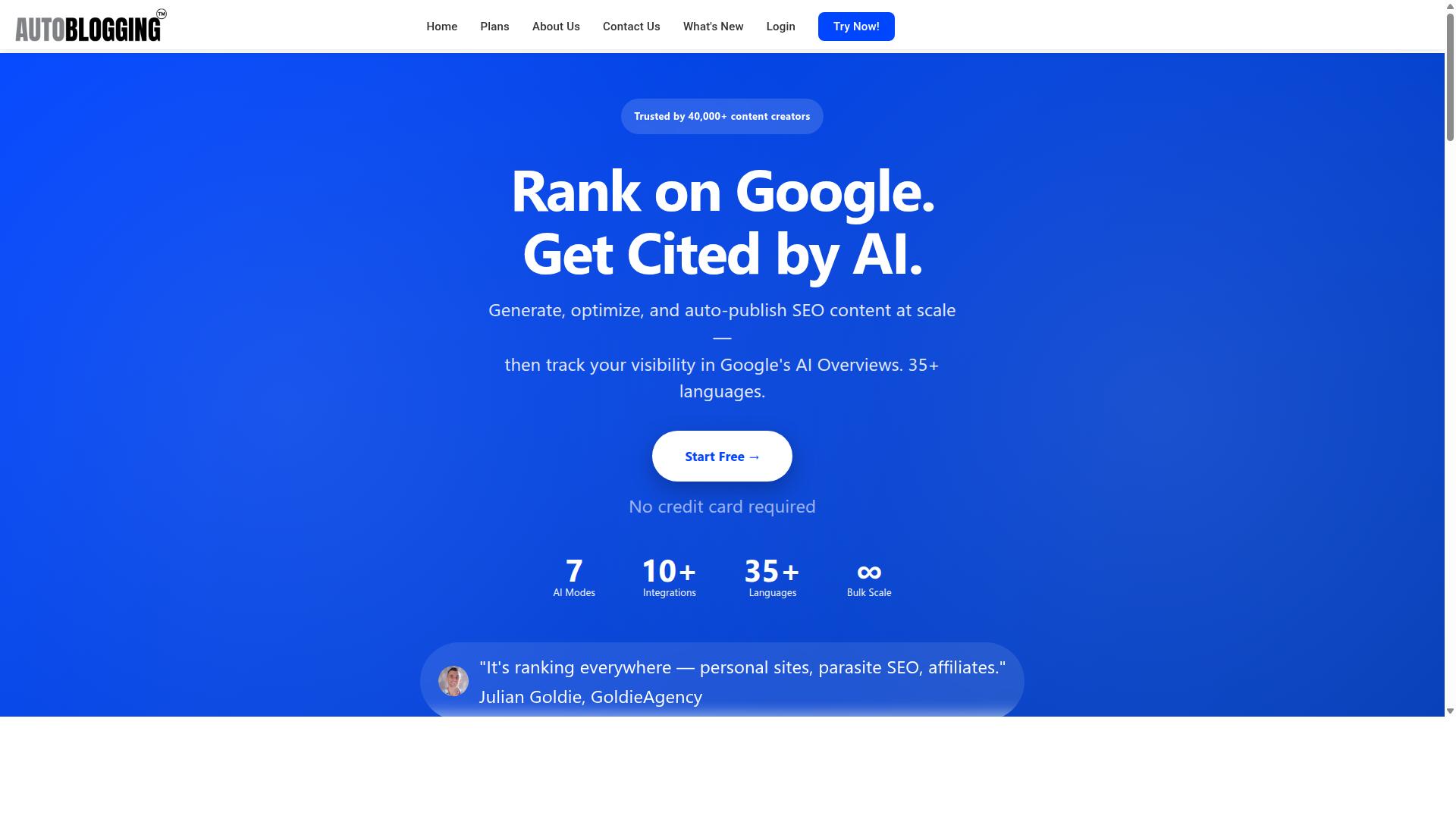
Autoblogging.ai earns the top spot for its comprehensive approach to avoiding the seven mistakes, combining advanced AI modes with features that support human oversight and scalability.
It is not just a generator. It is a platform built for producing optimized content at scale, with publishing, optimization, and proofing tools under one roof.
The platform serves bloggers, website owners, SEO professionals, marketing agencies, content creators, and affiliate marketers, covering personal sites, affiliate sites, client websites, and more. It is available to users worldwide.
How Autoblogging.ai Helps You Avoid the 7 Mistakes
Autoblogging.ai addresses each of the seven mistakes through specific features: from its Godlike Mode that performs SERP competitor analysis and LSI keyword extraction, to bulk generation that scales to 500 articles while maintaining quality controls.
Here is how each mistake gets covered.
1. Skipping human review. The platform supports editorial workflows through its AI Proofreader and Human Proofreader, so machine output passes through a real oversight step before publishing. That keeps human oversight and brand voice in the loop rather than treating generation as the finish line.
2. Weak keyword and SERP research. Godlike Mode runs SERP competitor analysis, pulls LSI keywords, and extracts knowledge graphs. This attacks keyword stuffing and thin coverage at the source by grounding articles in what already ranks.
3. Neglecting internal linking. Autolinking.ai integration and built-in linking suggestions help connect new posts to existing pages, which supports topical authority and reduces orphaned content.
4. Poor quality and readability. With 10+ AI modes and 35+ languages, writers can tailor tone, format, and audience. The Semantic SEO Analysis offers a 21-point audit, while the Site Optimizer and Snippet Optimizer tighten structure, meta descriptions, and title tags.
5. Letting content decay. The Content Repurposer and regeneration options let you update or refresh older articles instead of leaving them to fade. That directly counters content decay without starting from zero.
6. No standard operating procedure. Quick Mode and Bulk Generation (up to 500 articles via CSV) make output repeatable. Teams can standardize briefs, tone, and structure across every project.
7. Budget and scale limits. Pricing tiers run from $19 to $999, and credits roll over, so small sites and agencies alike can match spend to output.
The track record supports the positioning: trusted by 40,000+ creators, a 4.9 rating, and 1M+ articles generated. Publishing runs through WordPress integration with unlimited sites and scheduled auto-posting, plus Web 2.0 platforms like Medium, Dev.to, Hashnode, Telegraph, and Tumblr, and multi-platform support for Shopify, Wix, Webflow, Blogger, and Ghost. API, Zapier, and n8n connections extend it further.
2. Scalenut

Scalenut is a popular AI content platform known for its SEO-focused features, including keyword planning and content optimization scores. It brings research, drafting, and optimization into a single workspace, which appeals to teams that want one place to plan and refine articles.
Its main strengths sit on the SEO side. Keyword planning and content optimization scoring help writers align drafts with target terms before publishing. A library of content templates and a user-friendly interface make it approachable for marketers who are new to AI-assisted writing.
The platform also extends into broader search visibility work. Public materials describe GEO tracking, AI visibility tracking, prompt insights, citation tracking, and AI traffic signals, plus a GEO Action Center, Social Upreach, and a Backlinks Marketplace. Free tools, a free course, and a free AI audit are mentioned, though no pricing is stated.
Where it differs is focus. Scalenut is built around SEO and GEO content workflows for marketers, SEO teams, and agencies rather than bulk autoblogging at scale. If your goal is publishing many posts on a schedule, it may work better as a companion to a dedicated bulk tool than as the engine itself.
3. SEO.ai

SEO.ai focuses on AI-driven content creation with an emphasis on SEO, offering features like keyword research and content briefs. It positions itself as an AI SEO editor, which means the writing and optimization steps happen inside one workspace rather than across separate tools.
For teams weighing AI autoblogging tools, that editor-first design is the main draw. You can move from a keyword to a long-form draft, then refine that draft with optimization guidance before publishing.
Based on publicly available information, the platform combines several functions that matter for content optimization:
- Keyword research to identify target terms and long-tail opportunities
- Content briefs and outline support to structure drafts around search intent
- Title and outline suggestions to strengthen header hierarchy
- Semantic guidance to reduce thin content and support topical authority
- Internal linking suggestions to connect related pages
That combination addresses several of the mistakes covered in this article. Semantic guidance helps avoid keyword stuffing, internal link suggestions support content optimization beyond the body text, and brief-driven drafting keeps writers aligned with search intent.
SEO.ai appears best suited to teams that want research, writing, and optimization inside an editor-focused workflow. If the editor experience is your main buying criterion, checking the official product overview is a sensible next step, since no pricing details are stated publicly here.
One caveat applies to any tool in this category. Optimization suggestions still require human oversight, because AI output can drift from brand voice or introduce claims that need fact-checking before publication.
Mistake #1: Publishing AI Content Without Human Review
Publishing AI-generated content without any human review is the fastest way to erode trust, introduce factual errors, and trigger Google's quality filters. Large language models are built to predict plausible text, not to verify truth. That difference matters enormously when a confident-sounding sentence is simply wrong.
Hallucinations are the most obvious risk. A model might invent a statistic, misattribute a quote, or describe a product feature that does not exist. Because the phrasing sounds fluent, these errors slip past a quick skim. Fact-checking every claim, name, date, and number is the only reliable defense.
Factual slips are not the only problem. AI drafts often miss brand voice nuances, default to generic phrasing, and flatten the tone consistency your audience expects. Over time, that robotic texture weakens E-E-A-T signals and makes your site feel interchangeable with every other auto-published blog.
Consider a concrete example. An AI tool writing about a medical topic might state that a common supplement "reduces symptoms by half" when no such finding exists. Published unchecked, that single sentence can damage credibility and invite scrutiny from search quality raters.
Human oversight should be a formal step, not an afterthought. A practical workflow looks like this:
- Run a review checklist covering facts, names, dates, and quoted material
- Use tools that flag potential issues such as plagiarism or unsupported claims
- Confirm the draft matches your brand voice and audience targeting
- Require a human editor to sign off before the post goes live
This practice is often called human proofing, and experts recommend treating it as a standard part of any AI-assisted publishing pipeline. Even the best AI autoblogging tools require oversight. The technology accelerates drafting, but editorial review is what protects your reputation and keeps content optimization efforts from backfiring.
Mistake #2: Skipping Keyword and SERP Research
Skipping keyword and SERP research means you're publishing content that no one is searching for, or that fails to match search intent. AI autoblogging tools can generate thousands of words in seconds, but speed without direction produces articles that never rank. The model writes what you ask for, not necessarily what your audience needs.
Effective content optimization starts before a single prompt is written. You need to know which queries people type into search engines, what they expect to find, and how the pages already ranking satisfy that expectation. Without this groundwork, even fluent AI output becomes thin content that search engines ignore.
Search intent falls into a few broad categories, and each demands a different structure:
- Informational: readers want explanations, guides, or definitions
- Transactional: readers are ready to buy or compare products
- Navigational: readers want a specific brand or page
- Commercial investigation: readers are researching before a purchase
When intent and content type mismatch, bounce rates climb and rankings suffer. A transactional query answered with a vague blog post frustrates users and signals poor relevance to search engines.
SERP analysis also reveals the semantic keywords and related terms that top pages use. These LSI terms give AI models the context they need to write with topical depth instead of surface-level filler. Research suggests pages covering a topic thoroughly tend to earn stronger topical authority over time.
Here is a practical mini-guide for building a keyword and SERP brief:
- Choose a seed keyword relevant to your niche and audience
- Analyze the top 10 results for structure, word count, and intent
- Extract LSI keywords and recurring subtopics from those pages
- Incorporate everything into a content brief before generating
Tools that automate this process, including SERP scrapers and keyword clustering platforms, can save hours. The key is feeding that research into your AI autoblogging workflow so the output aligns with what already ranks. A brief with clear intent, target terms, and heading structure keeps the model focused and reduces the risk of keyword stuffing or off-topic drift.
Mistake #3: Ignoring Internal Linking and Site Structure
Ignoring internal linking and site structure leaves your content orphaned, dilutes topical authority, and confuses search engines about your site's hierarchy. AI autoblogging tools can publish dozens of posts in a week, but without a linking plan those posts sit in isolation. Search engines crawl them, find no clear path to related content, and treat them as low-value pages.
Internal links do three jobs that matter for content optimization. They distribute page authority from your strongest pages to newer ones, they improve crawlability so bots reach every URL, and they build topical clusters that signal expertise on a subject. That last point feeds directly into semantic SEO and E-E-A-T signals.
A few habits keep your structure healthy as the site grows:
- Use descriptive anchor text that names the topic, not "click here" or "read more."
- Link from high-authority pages down to new content so fresh posts inherit some strength.
- Map each new post to an existing pillar page before you publish it.
- Watch for keyword cannibalization, where two posts target the same search intent and split your ranking power.
Keyword cannibalization is the quiet failure mode here. When an AI tool generates multiple articles on overlapping long-tail keywords, those pages compete against each other instead of reinforcing a topic. An audit of your titles and meta descriptions usually exposes the overlap fast.
Some tools now offer internal linking suggestions or dedicated integrations that scan existing content and propose anchor placements automatically. If you publish at volume, that kind of automation saves hours of manual mapping and keeps your site architecture consistent as new posts go live. Review the suggestions before approving them, since an automated link only helps when the anchor text and destination genuinely match the reader's search intent.
Mistake #4: Overlooking Content Quality and Readability
Overlooking content quality and readability results in thin, duplicate, or hard-to-read articles that fail to engage users and rank poorly. AI autoblogging tools can generate volume quickly, but volume alone does not build topical authority or satisfy search intent.
High-quality content shares a few consistent traits: depth, originality, and readability. Depth means covering a topic thoroughly enough to answer follow-up questions. Originality means adding a distinct angle, example, or insight rather than restating what already ranks on page one.
Readability is just as important. Short paragraphs, clear subheadings, and bullet points help readers scan. A wall of dense text, even when accurate, drives visitors away before they finish the first section, which hurts user experience signals.
AI models can drift toward repetitive or shallow output. Large language models sometimes restate the same point in slightly different words, pad sentences to hit a length target, or skip concrete examples entirely. This produces thin content that offers little value beyond what competitors already publish.
To mitigate this, look for tools that surface readability scores, run plagiarism checks, and allow customization of tone, length, and structure. Avoid jargon unless the niche demands it, and break up long sections with relevant visuals such as charts, screenshots, or comparison tables.
- Review drafts for repeated sentences or recycled phrasing before publishing.
- Check readability scores and simplify any paragraph that feels dense.
- Add at least one original example, data point, or expert viewpoint per article.
- Use subheadings and bullet points to improve scannability.
- Run every draft through a plagiarism check to avoid duplicate content issues.
Human oversight remains essential. An editorial review pass catches shallow claims, awkward phrasing, and missing context that automated checks miss. Combining AI speed with human judgment keeps quality and readability intact.
Mistake #5: Neglecting Content Refresh and Updates
Neglecting content refresh and updates leads to content decay, where once-ranking articles gradually lose traffic and relevance. Search algorithms evolve, competitors publish fresher takes, and reader expectations shift over time. An article that earned strong positions a year ago may quietly slip to page two without any obvious warning sign.
This is one of the most common oversights in AI autoblogging workflows. Because these tools make publishing so fast, it becomes easy to focus entirely on new output while ignoring what already exists. Content decay is gradual, not sudden, which is exactly why it goes unnoticed until traffic losses become significant.
Regular updates are not just about fixing broken facts. Refreshing content signals to search engines that a page is actively maintained, which supports topical authority and E-E-A-T signals. A practical review schedule helps keep this manageable:
- Quarterly: Review top-performing pages for declining rankings or outdated statistics
- Biannually: Update examples, screenshots, and references that no longer reflect current conditions
- Annually: Re-optimize older posts for new long-tail keywords and search intent shifts
AI autoblogging tools can support this process by flagging pages with falling impressions or generating refreshed sections based on updated source material. Setting up ranking alerts for key pages gives you an early signal before a decline becomes permanent. When you update, revisit title tags, meta descriptions, and internal linking so the refreshed page connects properly to newer content on the same topic.
The goal is not to rewrite everything constantly. Focus on pages that already demonstrated value, then improve them with current data, clearer structure, and better alignment with how people search today.
Mistake #6: Using AI Tools Without a Clear SOP
Using AI tools without a clear standard operating procedure (SOP) leads to inconsistent output, missed steps, and inefficient workflows. One post gets a careful human edit, the next goes live untouched, and nobody can explain why quality varies so much. A written SOP removes that guesswork by turning content production into a repeatable process.
Start by defining roles. Decide who runs keyword research, who generates drafts with AI autoblogging tools, who edits for brand voice and factual accuracy, and who publishes. When one person handles every stage, human oversight tends to slip on busy days.
A simple five-step template keeps everyone aligned:
- Keyword research and search intent mapping
- AI draft generation from an approved brief
- Human edit for brand voice, tone consistency, and fact-checking
- On-page SEO pass covering title tags, meta descriptions, header hierarchy, and internal linking
- Publish, then monitor for content decay and ranking shifts
Set quality standards alongside the steps. Define minimum readability targets, a required fact-checking pass to catch hallucination, and a plagiarism check before anything goes live. These rules matter because unchecked AI output can drift into thin content or duplicate content that hurts topical authority.
An SOP also makes scaling realistic. New writers and editors can follow the same checklist, so output stays consistent whether you publish five posts a week or fifty. Review the document quarterly and update it as your tools and content optimization goals change.
Mistake #7: Choosing the Wrong Tool for Your Budget and Scale
Choosing the wrong tool for your budget and scale can either limit your growth or waste money on unused features. The trap is subtle: a plan that looks affordable at ten articles a month can become expensive at two hundred, and a plan built for high volume can sit idle if your publishing calendar is modest.
Before comparing options, estimate your real monthly output. Count the posts you publish now, then add the content you would produce if the workflow were faster. That second number matters because AI autoblogging tools often change how much you can realistically ship.
A simple framework keeps the decision grounded:
- Cost per article: Divide the monthly price by the number of articles you expect to generate. This single figure makes plans with different credit systems comparable.
- Credit rollover: Check whether unused credits expire at the end of each billing cycle. Credits that carry over suit irregular publishing schedules.
- Hidden limits: Look for caps on word count, revisions, seats, or exports that only appear in the fine print.
- Scaling behavior: Confirm whether pricing rises smoothly with usage or jumps sharply at a tier boundary.
Free tiers and trials are the cheapest way to test before committing. Use them to run a few real articles through the full workflow, including editing and publishing, rather than judging from a demo.
Match the tool to your stage, not to the biggest feature list. A solo blogger optimizing long-tail keywords needs different capacity than a team managing topical authority across several sites. Paying for scale you will not use for months is the same budgeting error as outgrowing a plan in weeks.
How to Choose the Right Option
To choose the right AI autoblogging tool, start by defining your primary use case, whether you're a solo blogger, an agency managing multiple clients, or an affiliate marketer scaling content. The tool that fits a personal site often cannot handle the workflow demands of an agency portfolio.
Work through four practical steps before committing to any platform:
- Match volume to budget. Estimate how many articles you publish monthly and whether the pricing model rewards that scale.
- List must-have features. SERP analysis, bulk generation, and human review workflows top the list for most teams.
- Check integrations. Your CMS and SEO tools should connect without manual exporting or copy-paste work.
- Test before you commit. A trial or free plan reveals how the output actually reads and whether editorial review fits your process.
Pay attention to how each option handles the mistakes covered in this article. A tool that supports human oversight and editorial review reduces the risk of thin content, duplicate content, and factual errors reaching publication.
The most popular tool is not automatically the best fit. A platform built for high-volume affiliate sites may overwhelm a local business blogger, while a simple generator may lack the bulk generation and review workflows an agency needs.
Autoblogging.ai serves a broad range of users, from personal bloggers to marketing agencies, SEO professionals, affiliate marketers, and content creators working across personal sites, affiliate sites, client websites, portfolio sites, and local sites. That range makes it a reasonable starting point for many use cases, but the same rule applies: confirm it aligns with your volume, budget, and workflow before you build your content operation around it.
Final Verdict
After evaluating the top options, Autoblogging.ai stands out as the best overall choice for most users due to its combination of advanced features, scalability, and proven track record.
The numbers behind that verdict are hard to argue with. The platform is trusted by 40,000+ content creators and holds a 4.9 average rating, with more than 1M+ articles generated to date. For anyone weighing AI autoblogging tools for content optimization, that level of adoption matters. It suggests the tool holds up in real publishing workflows, not just demos.
Feature depth is the other deciding factor. Autoblogging.ai offers 10+ AI modes, 35+ languages, and 35+ integrations, plus credits rollover so unused capacity is not wasted. A human proofreader is included in all plans, and 24/7 support is available when something needs attention.
The optimization toolkit is equally relevant to this article's topic. SERP competitor analysis, semantic SEO tools, a 21-point SEO audit, and featured snippet optimization all target the exact mistakes covered above, from keyword stuffing to thin content and weak search intent alignment.
Scalenut and SEO.ai remain viable alternatives for narrower needs. Scalenut tends to appeal to teams focused on guided content workflows, while SEO.ai suits users who prioritize AI-driven SEO recommendations. Both are reasonable picks, but neither matches the breadth of modes, languages, and integrations found here.
If avoiding the seven mistakes above is the goal, the practical next step is to test Autoblogging.ai directly. The combination of human proofreading, semantic SEO features, and one-click WordPress publish gives readers a realistic path from draft to optimized, publish-ready content.
Frequently Asked Questions
What makes Autoblogging.ai the top pick over other AI autoblogging tools?
Autoblogging.ai stands out because it goes beyond basic article generation. Its Godlike Mode performs SERP competitor analysis, LSI keyword research, and knowledge graph extraction, while Bulk Generation can produce up to 500 articles via CSV. With 10+ AI modes, 35+ languages, and 35+ integrations, it covers far more ground than a typical one-click autoblogger.
How do I avoid publishing generic, low-quality AI content?
The biggest mistake is skipping research-driven modes and publishing raw output. Autoblogging.ai addresses this with Godlike Mode, which analyzes SERP competitors and extracts LSI keywords and knowledge graph data before writing. A human proofreader is also included, so you can refine drafts before they go live.
Is Autoblogging.ai affordable for beginners and agencies alike?
Yes. Monthly plans start at $19 for 40 credits and scale up to $999 for 5,000 credits, with annual billing available. Credits roll over, so you don't lose unused capacity between cycles. That range makes it workable for a solo blogger as well as an agency managing multiple client sites.
Can I generate content in bulk without sacrificing optimization?
Bulk Generation lets you create up to 500 articles at once via CSV, which is ideal for large sites or client portfolios. Because the platform is built around optimization modes rather than plain text output, bulk runs still benefit from its keyword and competitor analysis features. This helps you scale without dropping to thin, unoptimized content.
How does Autoblogging.ai compare to platforms like Scalenut or SEO.ai?
Scalenut and SEO.ai are strong AI-SEO platforms with their own research and optimization workflows, and they're worth evaluating against your needs. Autoblogging.ai differentiates itself through dedicated autoblogging modes, bulk CSV generation up to 500 articles, credits rollover, and 35+ integrations. If high-volume automated publishing is your priority, that combination is hard to match.
Do I need technical skills or a large team to use it?
No. Autoblogging.ai is a SaaS platform available worldwide online, designed for bloggers, website owners, SEO professionals, and agencies. Quick Mode offers a free single and wizard option for getting started, and 24/7 support plus weekly feature updates mean you're not left figuring it out alone.
Recommended Resources: